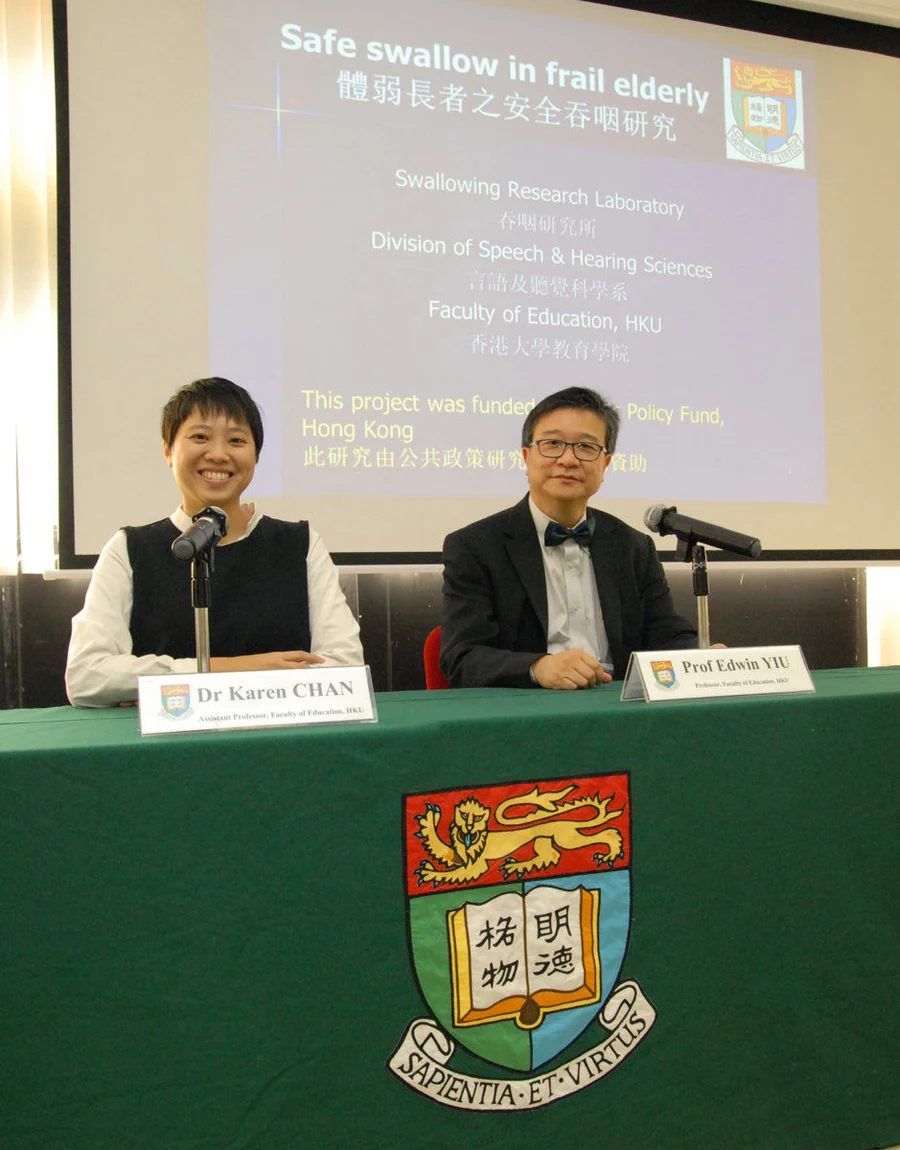
Swallowing problems are commonly found in the elderly population. Studies have shown that swallowing problems may lead to poorer quality of life, malnutrition, dehydration which could be fatal. The prevalence and impact of swallowing problems among the elderly in Hong Kong are still unclear. Therefore, the Swallowing Research Laboratory of the Division of Speech & Hearing Sciences, Faculty of Education, the University of Hong Kong (HKU), has recently conducted a study on safe swallowing in frail elderly living in the community. The study had two main focuses: 1) to investigate the prevalence of swallowing problems in elderly people living in subsidized residential care service units and those receiving subsidized community support services; and 2) to assess the swallowing management knowledge and skills of frontline staff at residential care service units and caregivers of home-living elderly who have swallowing problems. The study was funded by the Public Policy Research Funding Scheme.
The study was conducted in three phases: Phase I) to obtain statistical data on the prevalence of swallowing problems through phone interviews; Phase II) to evaluate the impact of swallowing problems and service satisfaction through face-to-face interviews; and Phase III) carers’ knowledge and skill assessment. In Phase I, all subsidized residential care service units and community support service units for the elderly in HK were invited to participate. A total of 34 residential units and 21 support units reported their number of elderly residents who had swallowing problems. In Phase II, research team members visited 22 residential units and 20 support units to conduct face-to-face interviews with the elderly. A total of 878 elderly people (around 43% had swallowing problems) participated in the second phase. Finally, in Phase III, 504 front line staff from the residential units and 93 family members who took care of the frail elderly at home participated in the study.