The 16-island Galapagos archipelago in the eastern equatorial Pacific host one of Earth’s most important biodiversity hot-spots. Famously, the land birds and reptiles provided Charles Darwin with key insights into Natural Selection, the mechanism that drives biological evolution. Today, the volcanic chain is arguably Earth’s greatest natural biological laboratory attracting researchers from across the World who “mine” the animal and plant repository looking for ever deeper understanding.
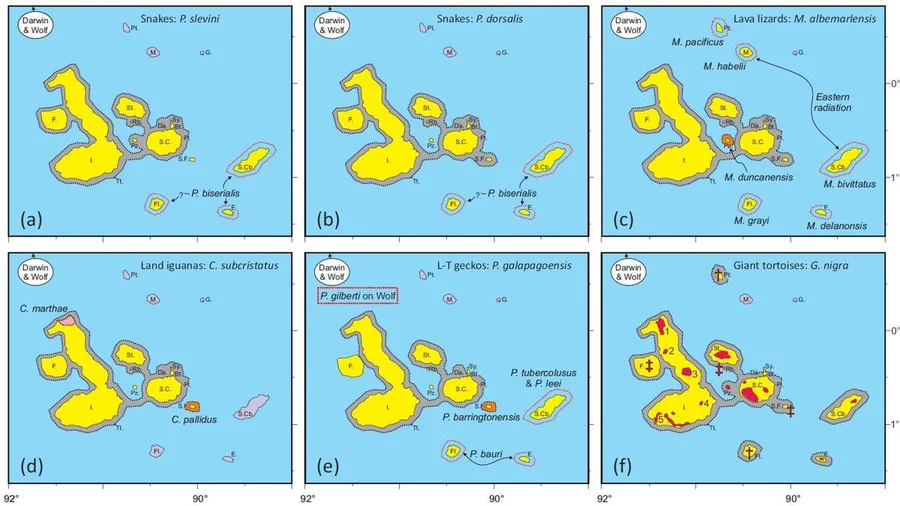
Oddly, although most scientists are happy with the notion that the original ancestors of each of the reptile groups (tortoises, snakes, land iguanas, lava lizards, geckos) rafted/floated in from the Americas more than 900 kilometers to the east, few consider how the descendents came to be scattered across the archipelago. Their investigations focus on the present, the broader story apparently irrelevant.
Now, new research by the University of Hong Kong earth scientist, Dr Jason Ali, and his University of Sydney geologist colleague, Prof. Jonathan Aitchison, is set to dramatically alter our view of Galapagos’ biology. Their work offers a comprehensive explanation as to why certain species are present on particular islands and absent from others, and how they got there. The investigation, however, carries a twist for it provides a radical new insight into the evolutionary development of a key fraction of the island chain’s species.
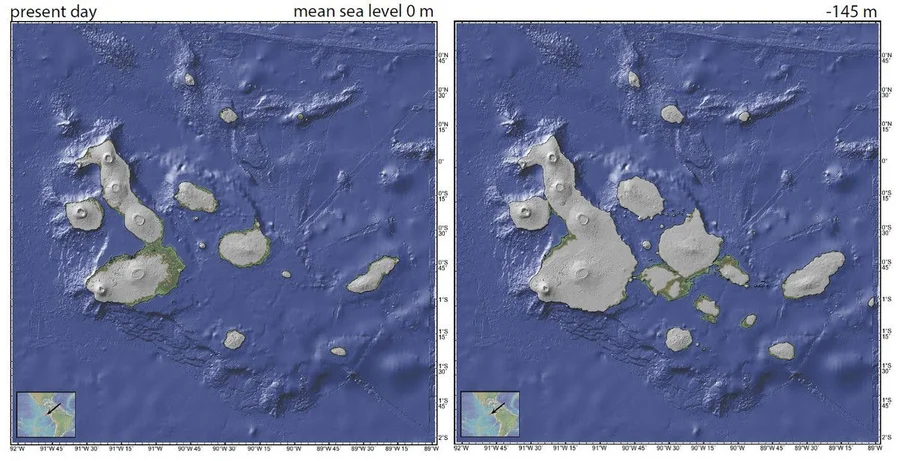
The study, to be published in the Journal of Biogeography, indicates that major shifts in sea level, caused by various climatic and geological processes, regularly reconfigures Galapagos’ geography. The extreme lows drop the shore-lines somewhere between 130 and 210 metres. At these times, the islands in the centre and west of the chain (“core”) coalesce into a mega-platform as illustrated in Figure 1 below. During these 10,000 year connection intervals, the long-isolated reptile forms are free to move around the new landmass. However, the sea-level rises that follow force them back on to higher ground where they are genetically trapped for around 90,000 years.