Professor Sun Hongzhe
Professor Sun Hongzhe is a professor of the Department of Chemistry at the University of Hong Kong. His research focuses on the biological inorganic chemistry and inorganic chemical biology, especially in metallomics and metalloproteomics. Professor Sun has published a series of work in understanding the functions of metalloproteins and the mechanisms of actions of bismuth-based metallodrugs. He is also a recipient of the Crouch Senior Research Fellow and the Convenor of the e-SRT on Integrative Biology.
Professor Sun was recipient of the HKU Outstanding Research Student Supervisor Award in 2013, awarded in recognition of his excellence in teaching and research.
More information about Professor Sun Hongzhe and his research group can be found from their group’s webpage: https://www.chemistry.hku.hk/staff/hzsun/website2013/Labpage/Home.html
Paper
“Rapid Labeling of Intracellular His-tagged Proteins in Living Cells”
at Proceedings of the National Academy of Sciences of the United States of America
https://www.pnas.org/content/early/2015/02/18/1419598112.abstract
Proceedings of the National Academy of Sciences of the United States of America, referred to as PNAS, is an official journal of the National Academy of Science, USA. PNAS is one of the world’s most-cited multidisciplinary scientific journals, covering publications in biological, physical and social sciences. PNAS is now celebrating the 100th anniversary of establishment.
Chemical Labeling of Proteins for Fluorescence Imaging and His-tagged Protein Library
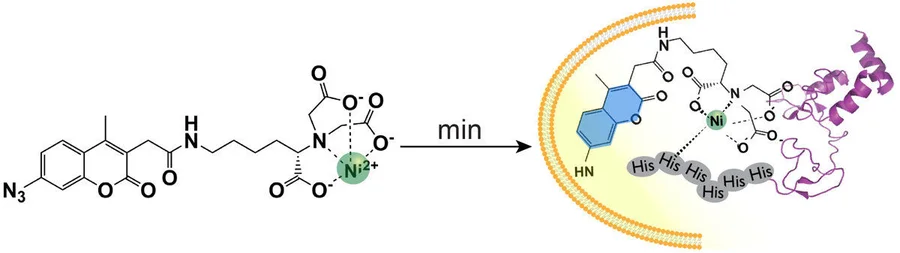
Chemical labeling of proteins is a technique to investigate the localization, functions and dynamic activity of target proteins in order to understand the biological events in living cells. Scientists have spent tremendous efforts to manipulate fluorescent labeling in studying cellular events. Although genetically-encoded tags (e.g. fluorescent protein-tag) can be readily expressed with target proteins inside cells, they possess potential in deleterious perturbation of protein functions due to their large size. Alternatively, small tag-based fluorescent imaging, utilizing synthetic fluorescent probe to site-specifically interact with short peptide-fused target proteins provides a solution. Successful small molecule-based fluorescent probes include biarsenical FlAsH and its derivatives which bind to the tetracysteine motif of intracellular proteins, and Ni2+-NTA-based probes which interact with the hexahistidine-tag (His-tag) on proteins.
His-tag labeling system has been widely applied in protein purification and elucidation of protein characterization for biological and biotechnological research owing to its advantage in monitoring cellular activities with minimal disturbance to the functions of target proteins. However, due to the constraints of poor membrane permeability of Ni2+-NTA-based fluorescent probes, tracking the large library of His-tagged proteins in living cells is still impossible.
It is, therefore, of great interest to construct membrane-permeable small fluorescent probes in real-time monitoring intracellular His-tagged proteins for the investigation of various cellular events in situ.
For press enquiry, please contact Ms Cindy Chan, Senior Communication Manager of Faculty of Science, at 3917-5286/ 6703- 0212 or by email at cindycst@hku.hk.
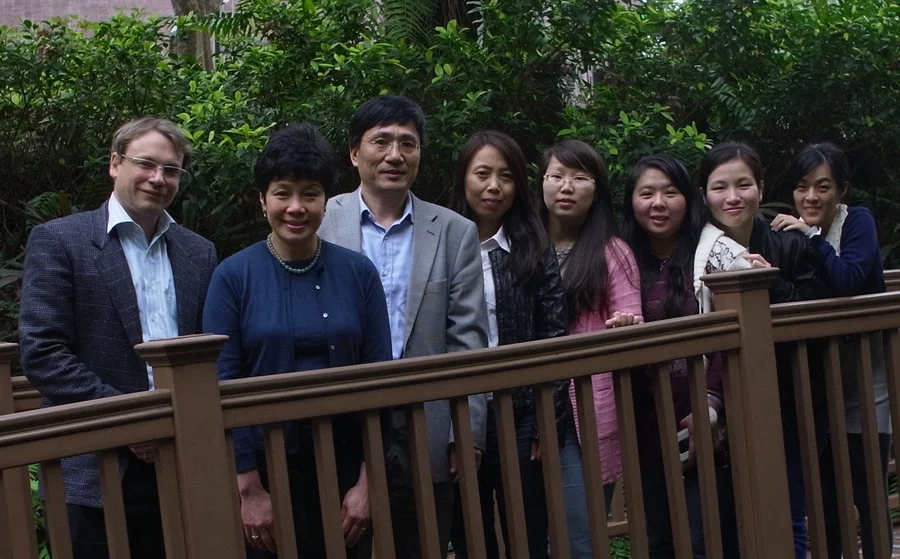
Professor Sun Hongzhe’s research team and his collaborators at HKU (from left): Dr. Julian A. Tanner (Dept of Biochemistry), Prof. Chye Mee-Len (Wilson and Amelia Wong Professor in Plant Biotechnology, School of Biological Sciences), Prof. Sun Hongzhe and his research group members from the Department of Chemistry: Dr. Li Hongyan, Miss Yang Ya, Dr. Lai Yau-tsz, Miss Chang Yuen-yan, Miss Chao Ailun
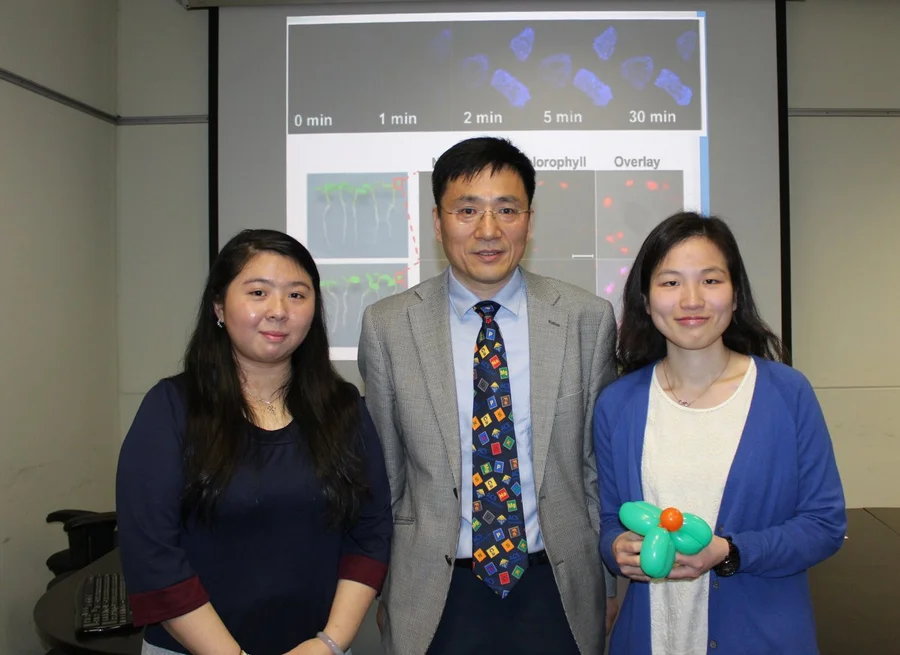
(From Left) Dr. Lai Yau-tsz and Miss Chang Yuen-yan, of HKU Department of Chemistry