On liquid-repellent surfaces, liquid droplets bounce away instead of being stuck. These surfaces are important in many fields, such as water-repellent clothes and anti-fouling kitchenware. Used as drag-reduction coatings for water vehicles, these surfaces can even help with speeding up cargo ships and military equipment so as to save energy. The dream of research and development on liquid-repellents is a structure that has robust liquid repellency, strong mechanical stability, and is inexpensive to produce on a commercial scale. However, the functional outcomes of existing liquid-repellent surfaces have not been satisfactory, because of inadequacies of conventional structural design and fabrication approaches in engineering microstructures and properties of such surfaces.
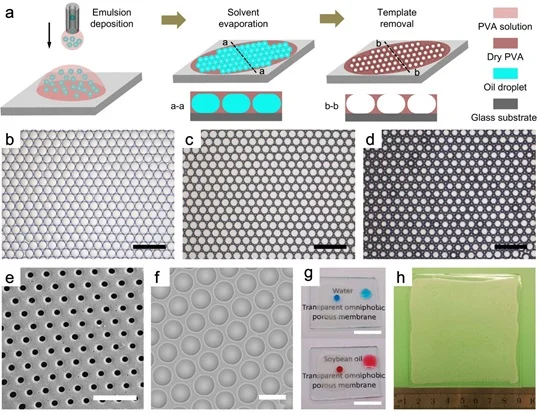
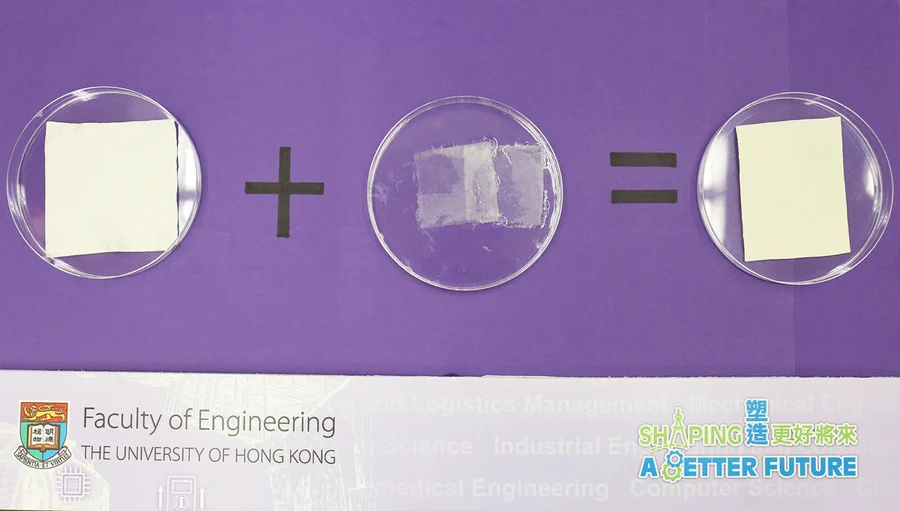
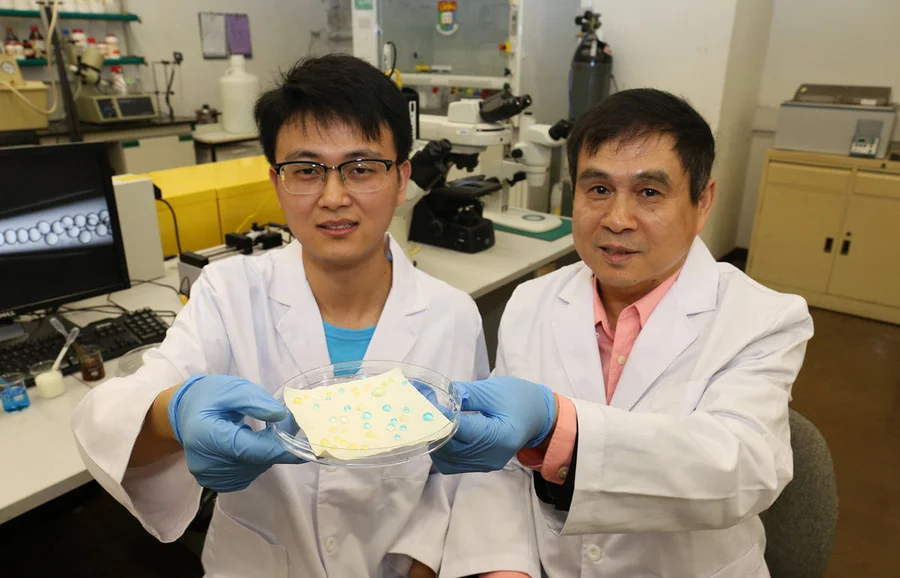
The challenge was recently overcome by breakthrough research led by Professor Wang Liqiu at the Department of Mechanical Engineering, Faculty of Engineering, the University of Hong Kong (HKU) through the development of a robust liquid-repellent structure and the fabrication of porous surfaces by an innovative microfluidic-droplet-based technique. Materials such as textiles, metals, and glasses covered by a layer of this robust porous surface can then become liquid-repellent. The paper was recently published in academic journal Nature Communications (Zhu P. A., Kong T. T., Tang X. and Wang L. Q. 2017. Well-defined porous membranes for robust omniphobic surfaces via microfluidic emulsion templating, Nature Communications 8, 15823). With the new technology developed by the team, clothes would never get wet on rainy days in the future.
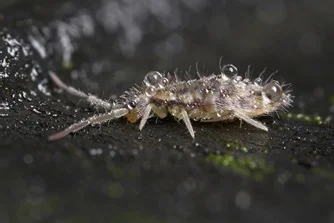
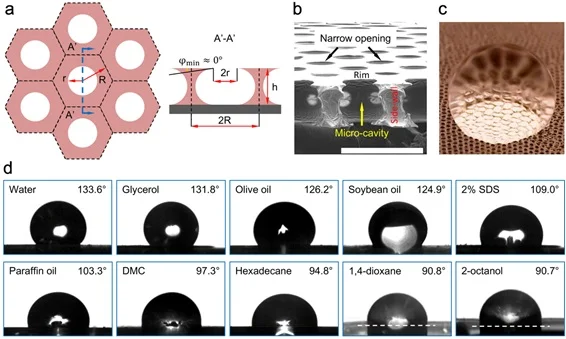
The team resolves effectively the conflict between liquid-repellency and mechanical stability by the springtail-cuticle-inspired design of liquid-repellent structures. Springtails are soil-dwelling arthropods whose habitats often experience rain and flooding. As a consequence, springtails evolve their cuticles with strong mechanical durability and robust liquid repellency to resist friction from soil particles and to survive in watery environments, respectively. Inspired by springtail cuticles, the research team designed porous surfaces composed of interconnected honeycomb-like micro-cavities with a re-entrant profile: interconnectivity ensures mechanical stability and re-entrant structure yields robust liquid-repellency.