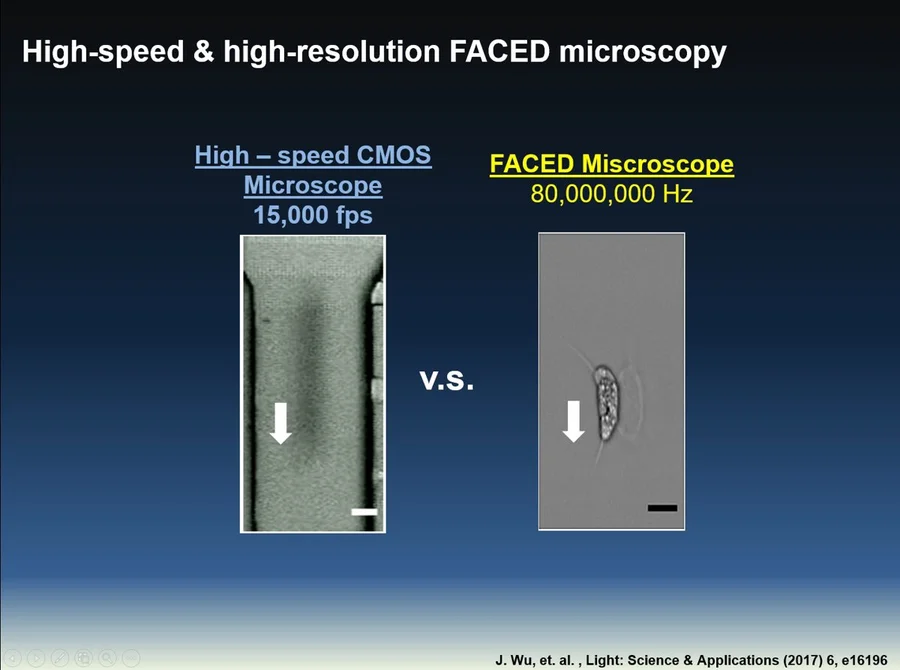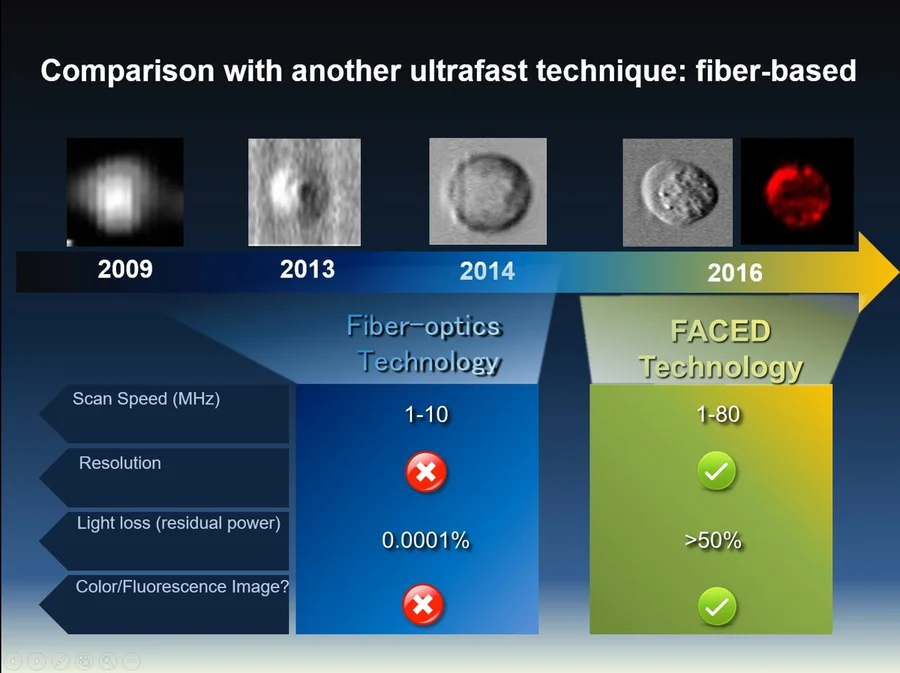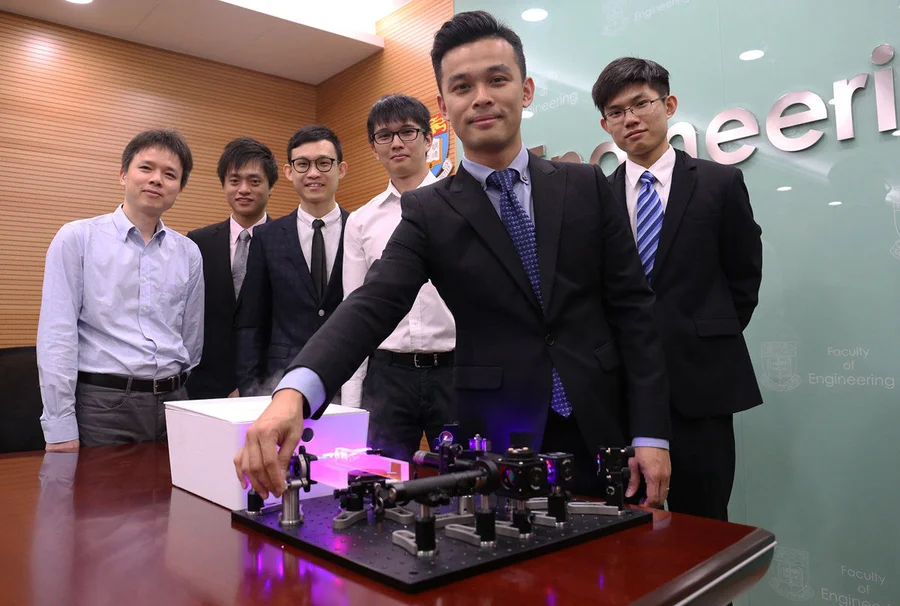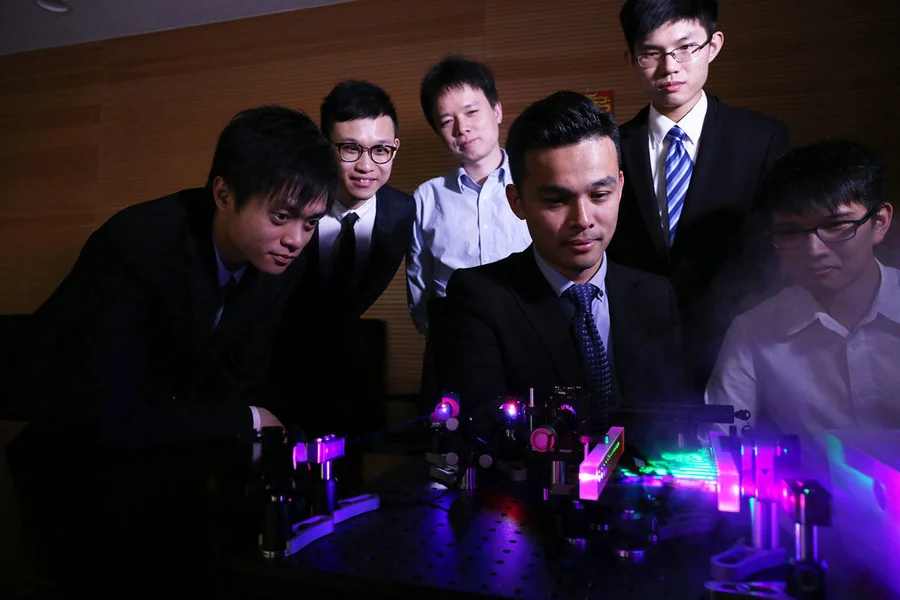
Dr Kevin Tsia, Associate Professor in Department of Electrical and Electronic Engineering at the University of Hong Kong and his research team developed a new laser-scanning imaging technique that overcomes the limitations of existing technologies, providing more than 100 times faster in scan speed with high image resolution.
Laser-scanning imaging is the workhorse widespread in many applications, ranging from routine optical microscopy in scientific research (e.g. biology, material science) and biomedical diagnosis to machine vision in industrial manufacturing processes.
The new technique not only can resolve the current challenge to meet the ever-increasing demand for speed and throughput, but could also empower new discovery in basic scientific research, with potential applications in a new generation of biomedical microscopy for precise and early diagnosis of diseases.
The work was published in Light: Science and Applications in January 2017.
Dubbed free-space angular-chirp-enhanced delay (FACED) imaging, at the heart of the innovative technique is the “infinity mirror” – a pair of parallel mirrors. Researchers applied this “device” with a subtle twist (~ 0.01 degree). They combine ultrafast pulsed laser and a “tilted” mirror-pair to create an ultrafast sweeping laser beam. The pulsed beamlets are projected onto different positions at different arrival times and behave as a scanning optical beam.
“Notably, being 100 times faster in imaging speed than state-of-the-art imaging flow cytometers without losing the image information content, this technology could be an effective and efficient tool to analyse individual cells, e.g. cancer cells, in great details within an enormous population of cells,” said Dr Kevin Tsia.
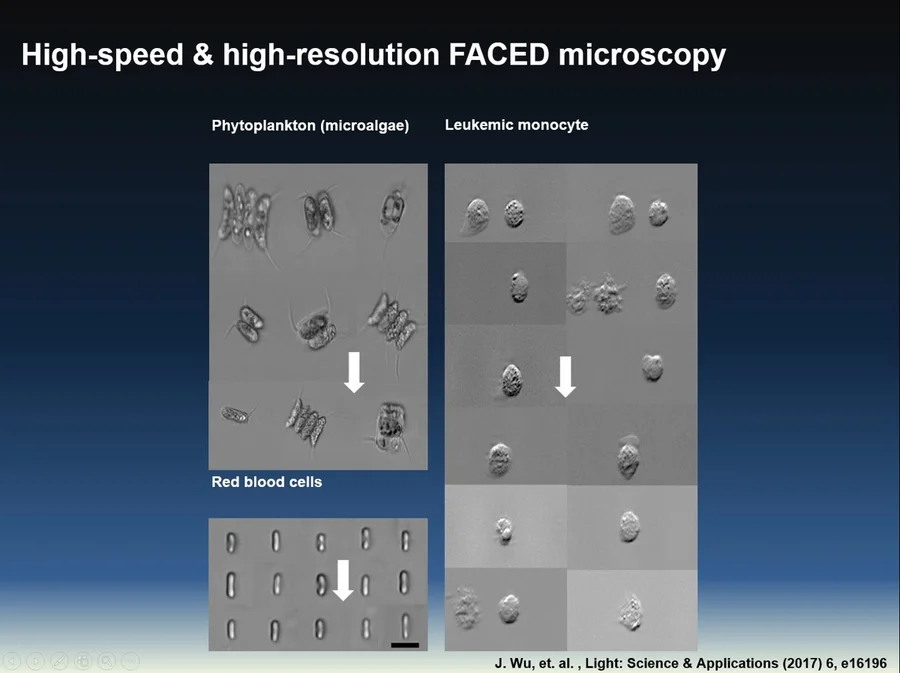
Combining FACED imaging with microfluidic technology, the team demonstrated high-resolution and high-throughput single-cell imaging at 10,000 to 100 000 cells per second, which is almost 100 times faster than current microscopy. Such a high throughput imaging could be particularly beneficial for cancer diagnosis by providing an effective and efficient method to detect rare cancer cells in a pool of billions of blood cells.
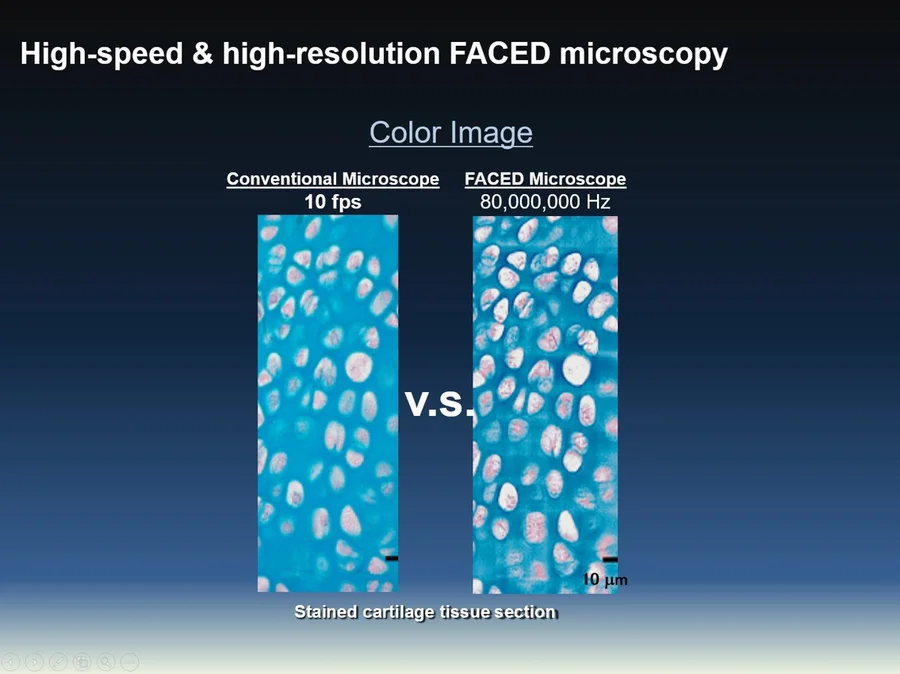
“It opens new potentials where high-speed and high-throughput biological microscopy are needed but were once out of reach. They are ultrahigh-throughput whole-slide imaging for digital histopathology, large-scale microalgae screening for harmful algal bloom monitoring in marine biology study. The technology can also be applied to high-speed cellular dynamics monitoring, for example, neuronal firing for studying complex brain functions and diseases including brain degeneration like Alzheimer or brain disorder,” he added.
“Current standards of laser scanning are predominantly based on mechanical scanning mirrors to steer the laser beam direction. But, their scanning speed are inherently limited by mechanical inertia and can only reach up to about 10-100kHz,” explained by Dr Wu Jianglai the postdoctoral researcher of the work, adding: “the beam scanning action of FACED is in contrast done without any moving parts and its speed is simply governed by the flashing rate of the pulsed laser, which could easily be MHz and above achieved by current laser technology.”