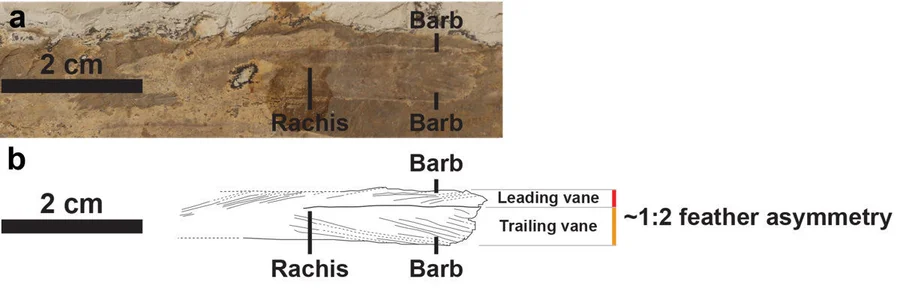
Dr Pittman said: “The asymmetrical feathers that we reported on the tail of Jianianhualong tengi is the first record of these aerodynamically associated feathers in troodontid dinosaurs.”
“Now that we know birds, dromaeosaurids and troodontids all have representatives with asymmetrical feathers; we reconstructed these feathers at their closest common ancestor (the closest common ancestor of birds). This means that this feature (asymmetrical feathers) evolved earlier than previously thought - at least 160 million years ago - because a common ancestor is always older than its descendant groups.” He added.
“Birds have asymmetrical feathers that have been associated with flight capability, but they are also found in species that do not fly. We therefore cannot say that Jianianhualong glided or flew based on these feathers alone. However, we can say that the aerodynamic capabilities conferred by these feathers would have benefited its locomotion, be it ground-based or through the air (gliding and flying). This study makes important steps towards reconstructing the early evolution and function of asymmetrical feathers.” He explained.
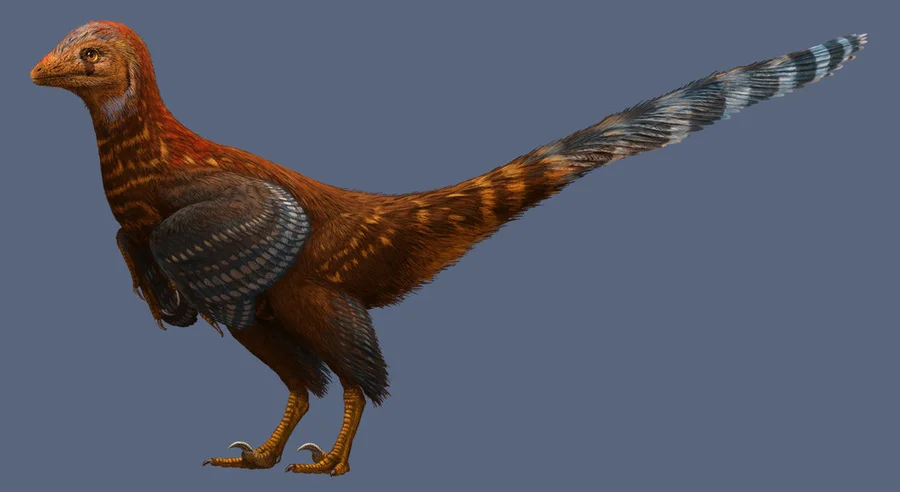
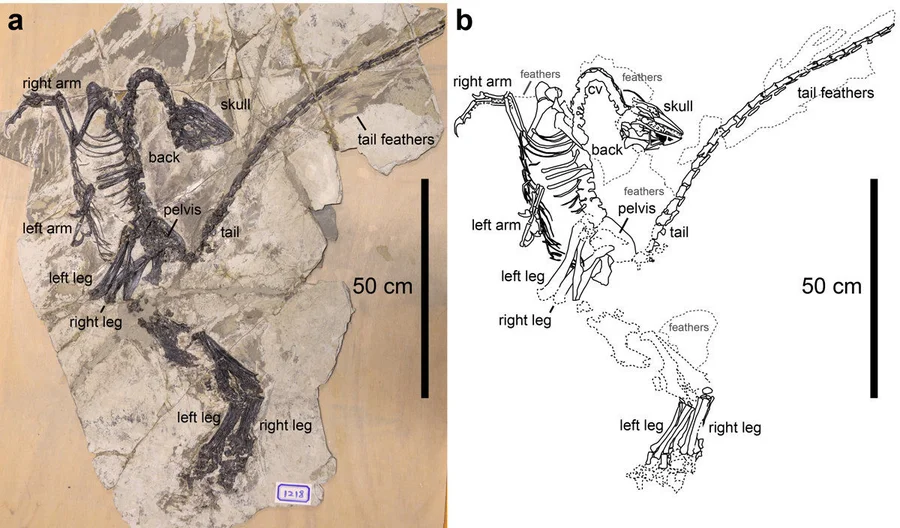
In addition, Jianianhualong tengi represents an important transitional form in the evolution of troodontids. By making comparisons with other troodontids, Dr. Pittman and his colleagues show that Jianianhualong tengi and another troodontid Sinusonasus magnodens underwent mosaic evolution - some portions of their skeletons evolved without simultaneously affecting the evolution of other portions. For example, the forelimbs and hip region of Jianianhualong tengi are similar to primitive troodontids whereas its skull and hindlimbs are more similar to advanced troodontids. These new insights show that even small dinosaur groups can experience this phenomenon, helping us to understand how these animals and their avian cousins evolved.
Jianianhualong tengi is housed in the Dalian Xinghai Museum in Liaoning Province, China and its specific name tengi honours its curator Teng Fang Fang who secured the specimen for scientific study. This research was co-led by Prof. Xing Xu from the Institute of Vertebrate Paleontology and Paleoanthropology (Chinese Academy of Sciences), Prof. Philip Currie from the University of Alberta and Dr. Michael Pittman from The University of Hong Kong.
In February this year, Dr Pittman and his collaborators reported the first high-detail body outline of a feathered dinosaur in Nature Communications, based on high-definition images of soft tissues revealed by laser-stimulated fluorescence (LSF) imaging.
Dr. Pittman and Prof. Xing Xu are currently offering a free HKU online course Dinosaur Ecosystems. For more details about dinosaurs and Dr Pittman’s online course, please visit: https://www.edx.org/course/dinosaur-ecosystems-hkux-dinox.
The journal paper can be viewed at: http://dx.doi.org/10.1038/NCOMMS14972
Image download and illustration: http://www.scifac.hku.hk/news/media?page=1
For media enquiries, please contact Dr. Michael Pittman, Research Assistant Professor, HKU Department of Earth Sciences. Since Dr. Pittman is currently out of HK, email contact at mpittman@hku.hk is preferred (or tel: 34 603 330 627/ 852 3917 7840); or Ms. Cindy Chan, HKU Faculty of Science (tel: +852 3917 5286; email: cindycst@hku.hk).

![The tail frond of the troodontid Jianianhualong tengi DLXH 1218. (a) Photograph, and (b) laser-stimulated fluorescence [LSF] image of the fossil tail frond. Scale is 2cm. Credit. Xu, Currie, Pittman et al. 2017.](/adobe/dynamicmedia/deliver/dm-aid--541ef018-b6c6-4f11-8360-df76917cc827/Figure_3_NCOMMS_PR.jpg.webp?preferwebp=true&width=900)