Scientists have long been intrigued by the surfaces of terrestrial bodies other than Earth which reveal deep similarities beneath their superficially differing volcanic and tectonic histories.
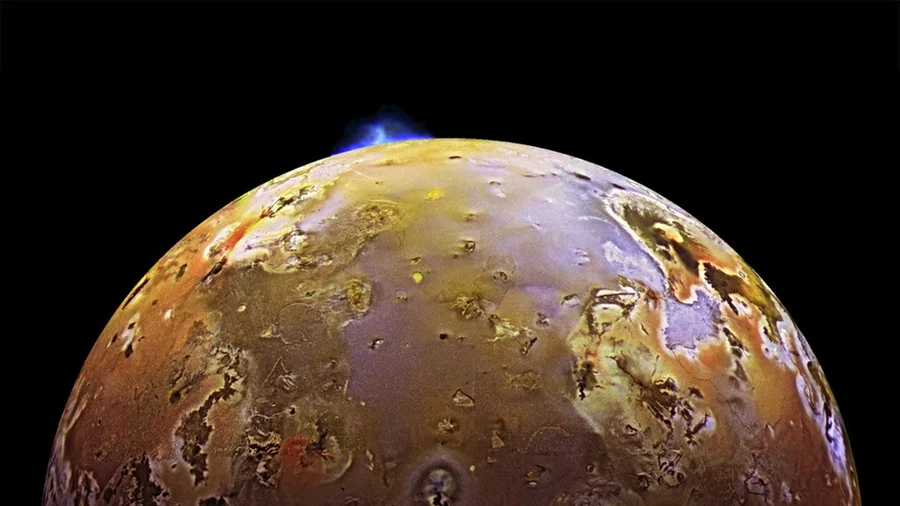
A team of scientists from NASA, Hampton University and the University of Hong Kong propose a new way of understanding the cooling and transfer of heat from terrestrial planetary interiors and how that affects the generation of the volcanic terrains that dominate the rocky planets. Based on the present dynamics of Jupiter’s tidally heated moon, Io, the scientists hypothesize that the geological histories of the solar system’s terrestrial bodies, specifically Mercury, Venus, Moon and Mars, are consistent with a mode of early planetary evolution involving heat-pipes. They further propose that heat-pipe cooling is a universal process that may explain the common features seen on the surfaces of terrestrial planets.
The team’s findings are discussed in a paper recently published in Earth and Planetary Science Letters.
“We believe that the concept of a heat-pipe mode of planet formation is important and will help explain the evolution of all rocky planets,” said Dr. Justin Simon, NASA Planetary Scientist, Center for Isotope Cosmochemistry and Geochronology in the Astromaterials Research and Exploration Science Division at NASA’s Johnson Space Center in Houston, Texas and one of the coauthors of the paper. “If shown to be correct, it will be discussed along with the theories of plate tectonics, planetary ‘magma oceans’ and the ‘giant impact theory for the origin of the moon.’”
The scientists hypothesize heat-pipe cooling was involved in the evolution of all terrestrial planets including early Earth and represents the transition from the magma ocean to the rigid-lid or plate tectonic modes of planetary evolution. Heat-pipes transport heat from the interior to the surface via mantle melting and magma ascent. The resulting eruptions lead to global volcanic resurfacing by which older volcanic layers are progressively buried and pushed downward to form thick, cold and strong mechanical lithospheres.
The authors review the observations relevant to the formation of the surfaces of each of the terrestrial planets and current models that have been proposed to explain them. They then discuss the major outstanding problems and show how the heat-pipe hypothesis can resolve these in a consistent way across all planets.