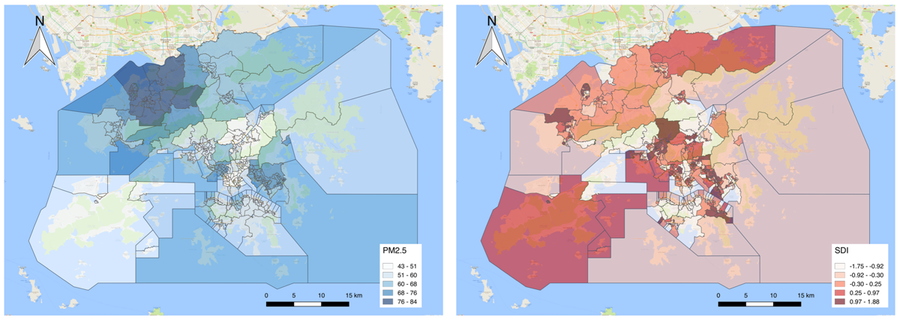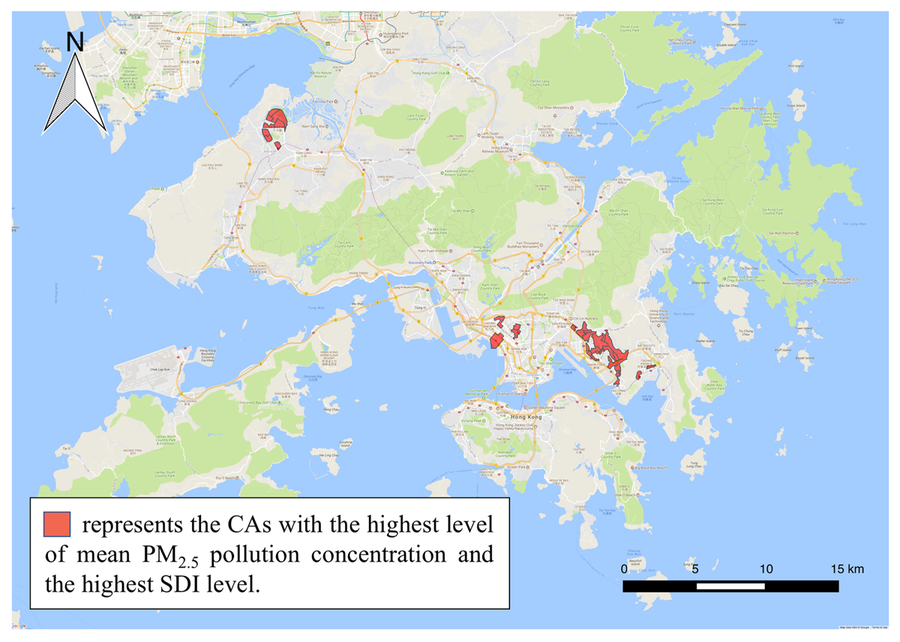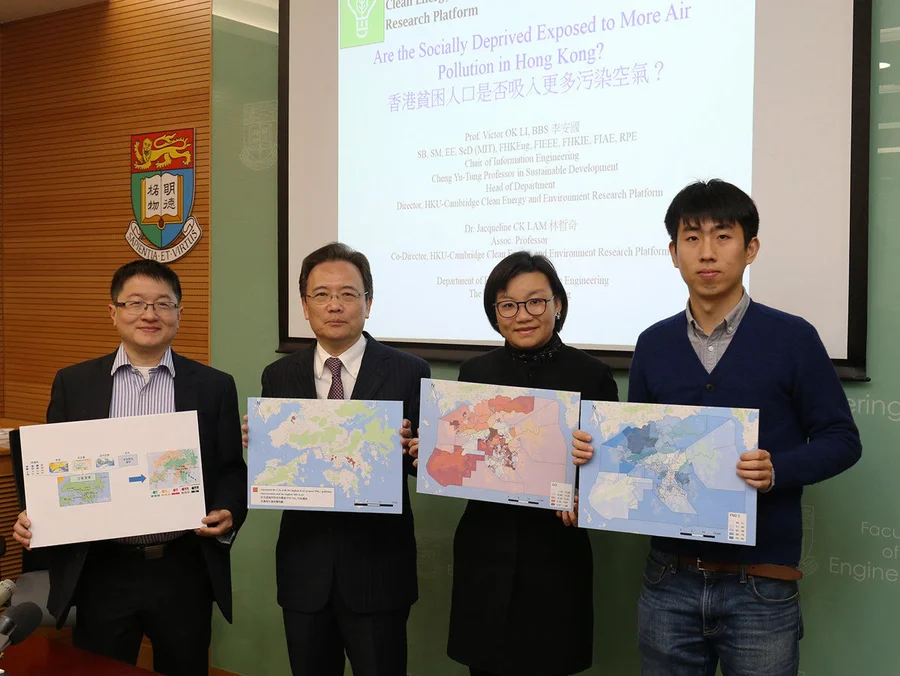
Poor air quality can result in extremely detrimental health consequences, such as cancer, stroke, asthma or heart disease [1, 2]. Interdisciplinary research conducted by the HKU-Cambridge Clean Energy and Environment Research Platform (HKU-Cambridge CEERP) revealed that there is a statistically significant, positive relationship between ambient PM2.5 (Particulate Matter of width 2.5 microns or less) concentration and the Social Deprivation Index in Hong Kong, and showed the existence of air pollution-induced environmental injustice at the constituency area level in the territory. The paper was recently published in the journal Environmental Science and Policy (Li, V.O.K., Han, Y., Lam, J.C.K., Zhu, Y., and Bacon-Shone, J., 2018, Air pollution and environmental injustice: Are the socially deprived exposed to more PM2.5 pollution in Hong Kong?, 80, 2018, 53-61).
The starting point for the research was: Are the socially deprived exposed to a higher level of air pollution in Hong Kong? Can this exposure to air pollution therefore be seen as environmental injustice? Existing research on air pollution-induced environmental injustice in Hong Kong was based on sparse air pollution data due to the limited number of government pollution monitoring stations (only 16, one added recently) in the territory, rendering it difficult to study the relationship between air pollution exposure and social deprivation (SD), and hence the study of environmental injustice, at finer geographical scales.
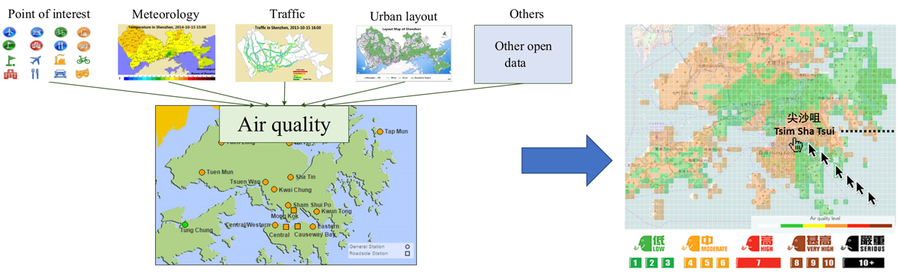
This challenge was recently overcome by a breakthrough research led by Professor Victor Li On-kwok, Director of HKU-Cambridge CEERP and Head of Department of Electrical and Electronic Engineering (EEE), Faculty of Engineering, HKU and Dr Jacqueline Lam Chi-kei, Co-Director of CEERP and Associate Professor at the HKU Department of EEE, through the development of a Granger Causality Model. This model utilised readily available urban dynamics data closely related with air pollution as proxy data, including ambient pollutants concentration, traffic, meteorology and urban morphology to provide a fine-grained (100m × 100m) estimation of air pollution in Hong Kong, transforming the measurements of 16 government monitoring stations to 110,000 virtual stations. Ambient pollutants concentrations are available from Hong Kong Environmental Protection Department, vehicular traffic data from Hong Kong Transport Department, meteorology data from Hong Kong Observatory, and urban morphology data including urban layout and roadmap from Baidu Map. The fine-grained estimation allows us to identify the areas with the highest level of pollutants concentration, thus providing important inputs for policy-making.