Dr. Chiribella’s research interest explores the fascinating world of quantum information science, an interdisciplinary area at the intersection of computer science, physics, and applied mathematics. His best known work “Informational Derivation of Quantum Theory” is a milestone in the foundation of quantum mechanics and sheds new light on the power of quantum computers. By identifying the working principles of quantum information, Chiribella’s research is pushing forward the development of new applications and new technologies in areas including data security and precision measurements, to achieve breakthroughs that are beyond imagination.
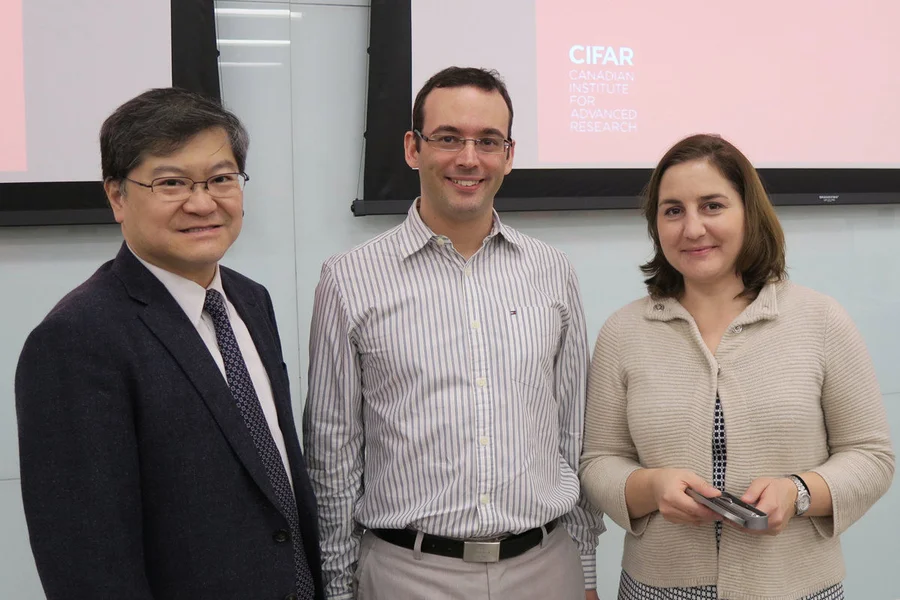
“Giulio leverages the principles of quantum mechanics to design new devices that push our information technology towards its ultimate limits. It’s this enthusiasm for pairing boundary pushing research with real-world impact that really stood out to us,” added Dr. Kanellis.
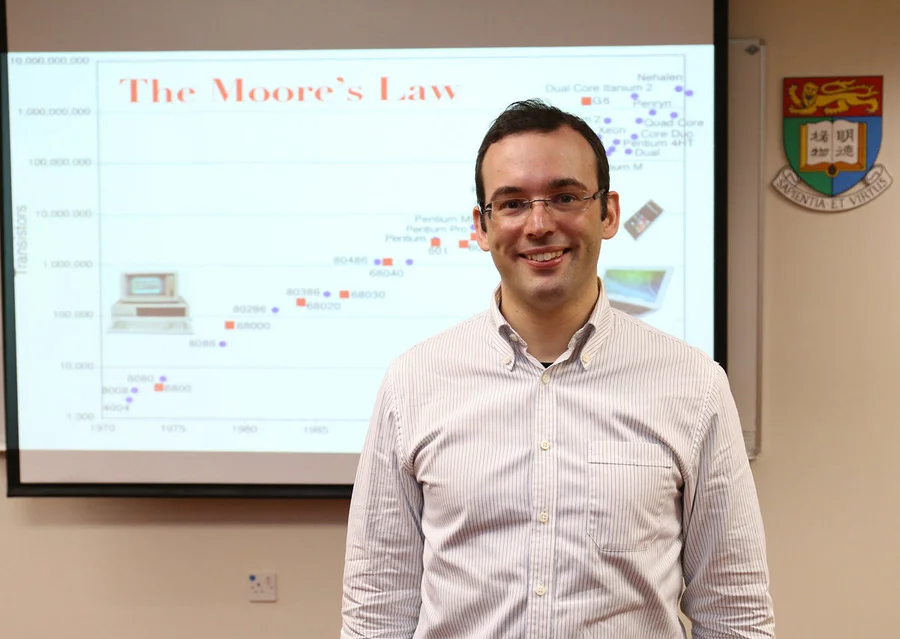
The power of nowadays computers is the result of a trend of hardware miniaturization lasted for about four decades. Quantum scientists have been exploring since the nineties the possibility of creating super-fast quantum computers, which could solve difficult mathematical problems which standard supercomputers could not find the answer within the lifetime of the universe. With the help of a quantum computer, one could predict the behavior of complex systems, from chemical reactions to the stock market, or design and test new materials. Quantum computers could also help to analyze the massive amounts of data that the internet is generating every day. Ultimately, quantum computers could hold the key to build intelligent machines capable to learn faster than the current prototypes, opening a new era for artificial intelligence.
On the other hand, a quantum computer could break down secret codes and solve difficult mathematical problems in the blink of an eye, breaking in the most secret databases, stealing financial or even military information, posing potential threat to our security and communication systems such as emails and credit cards.
Fortunately, quantum mechanics also opens the door to totally new codes that are guaranteed to be unbreakable by the very laws of nature. China is one of the leading players in the development of quantum communication networks, with a visionary project that will enable secure communication through satellite links. Very recently, the satellite Mozi was sent in orbit to become the first element of a future satellite network dedicated to quantum communication. Mozi can communicate secretly with a number of ground stations, using a quantum technology based on the principle of “quantum entanglement”, a mysterious type of relation that can exist between particles very far away from each other. Dr. Chiribella’s research team has delved deeply into quantum entanglement, showing connections between the security of quantum communication, the precision of quantum sensors, and the speed of quantum computers.
Dr. Chiribella’s team is now exploring how quantum devices can be controlled with minimum amounts of resources, with applications ranging from energy-efficient computing to quantum sensor networks and to the simulation of complex systems. In its characteristic and original way, Chiribella’s team is contributing to a worldwide quest, which engages researchers from top research centers, like Singapore’s Center for Quantum Technologies, and Waterloo’s Institute for Quantum Computing, governmental agencies such as NASA and NIST, and leading companies such as IMB, Google, and Microsoft.
Dr Chiribella said: “In addition to the research ahead, what I find exciting about the CIFAR-Azrieli Program is the opportunity to be part of a global network that joins many of the leading scientists in my field. I am thrilled to the idea that, with the support and mentoring of the CIFAR network, our group at HKUCS could contribute to the vibrant landscape of quantum information in Hong Kong, as well as the development of an international hub for cutting-edge research in the field.”
Chiribella came to HKU in August 2015 from Tsinghua University, where he previously served as an associate professor and member of the Young 1000 Talents Program of China. Earlier, he did research at Perimeter Institute for Theoretical Physics, the leading worldwide center for the foundations of quantum mechanics.
For media enquiries, please contact: Ms Melanie Wan (Senior Manager (Media), Communications and Public Affairs Office) tel: 2859 2600/ email: melwkwan@hku.hk; or Ms Esther Lau, Faculty of Engineering, HK, tel: 3917 1924 / email: estherlc@hku.hk.